
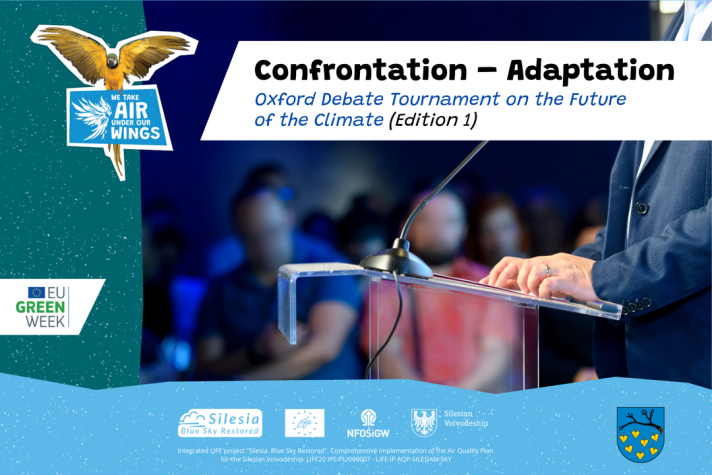
Can young people help shape the future of our cities in the face of climate change? The ‘Confrontation – adaptation’ Oxford debate tournament demonstrates that they can. At the Municipal Public Library in Łaziska Górne, eighth-grade students face each other in an intellectual contest where knowledge, reasoning and strong arguments become tools for environmental action.
The Oxford debate format is one of the most engaging forms of discussion. It requires logical thinking, persuasive argumentation and teamwork. During the tournament, students analyse theses related to climate adaptation, meaning actions that help cities and communities prepare for the impacts of rising temperatures, extreme weather events and water shortages. Participants address questions that increasingly appear in public debate, such as what cities of the future should look like, whether expanding urban greenery can significantly reduce temperatures in city spaces, what role local communities play in adapting to climate change and how investing in nature through urban green areas, water retention and biodiversity can help create more resilient and liveable environments.
The debate format requires teams to defend or challenge the proposed motions using arguments based on scientific knowledge, real-life examples and their own observations. Through this process, participants expand their environmental knowledge while also developing critical thinking skills and the ability to engage thoughtfully in discussions about the planet’s future.
The ‘Confrontation – adaptation’ tournament reflects the idea of this year’s EU Green Week, which highlights investing in nature as a key strategy for building a more resilient and sustainable future. It also emphasises the importance of educating younger generations, the people who will soon make decisions shaping the environment.
This event demonstrates that change often begins with dialogue and that one of the most important investments in nature is the knowledge, awareness and engagement of young people.
The event is organised as part of the project ‘Silesia. Blue Sky Restored’.
Host: Anna Kocima, eco-manager of the Municipality of Łaziska Górne.
- biodiversity | bioeconomy | clean technology | environmental impact | green economy | innovation | renewable resources | sustainable economic growth strategy
- Tuesday 2 June 2026, 14:29 (CEST)
- Łaziska Górne, Poland
Practical information
- When
- Tuesday 2 June 2026, 14:29 (CEST)
- Where
- Municipal Public Library1 St. John Paul II Street, Łaziska Górne, Poland
- Languages
- Polish
- Website
- Event website
- Social media links